
S4E167: Water Trough Chat: Why The Lindsay Clancy Case Feels Terrifying For People With OCD
The Lindsay Clancy case has sparked intense conversations about postpartum mental health—and for many people with OCD, those conversations can be terrifying.
In this special Water Trough Chat, Nicole welcomes back OCD specialist Gina Abbondante, LCSW, who brings nearly 20 years of maternal mental health experience. Together, they explore perinatal OCD versus postpartum psychosis, intrusive thoughts, psychosis, hormonal influences, and why this case has created so much fear and confusion within the OCD community.
They also discuss the polarization surrounding the case and what happens when we try to force an incredibly complicated tragedy into black-and-white explanations.
Content Warning: Includes discussion of child death, filicide, suicide attempts, intrusive harm thoughts, psychosis, and severe perinatal mental illness.
Resources:
For more info about Gina Abbondante, LCSW, click here.
To check out Gina’s Perinatal OCD vs. Postpartum Psychosis training through OCD Training School, click here to use my special link.
To check out provider searches, check out the following:
The International OCD Foundation Provider Search: Click here
ICBT.online’s Provider Directory: Click here
S4E166: Water Cooler Chat: Barefoot In Seattle: The 31st IOCDF Conference Recap
In this Water Cooler Chat, Nicole is joined by her Seattle roomies and fellow OCD specialists Amanda Petrik-Gardner and Angela Henry to recap the 31st Annual IOCDF Conference.
The trio talks conference highlights, including expanded conversations around OCPD and PANS/PANDAS, the inaugural in-person I-CBT Special Interest Group meeting, evolving evidence-based treatment options, and why bringing clinicians, researchers, families, supporters, and people with lived experience together matters so much.
And because this is the OCD Family Podcast, there are plenty of roommate shenanigans along the way—including one very unexpected, exposure-filled barefoot walk through the streets of Seattle.
Come for the OCD education, stay for the dirty feet.
Resources:
To learn more about our guest, Amanda Petrik-Gardner, LCPC, check out the following:
Instagram: @anxietyocdtreatment
Website: www.amandalcpc.com
LinkTree: linktr.ee/anxietyocd
Prior episodes featuring Amanda on OCD Family Podcast:
To learn more about our guest, Angela Henry, LCSW, check out the following:
Instagram: @ctr_for_collaborative_healing
Website: https://angelahenrylcsw.com/
MIND Global Council: https://www.mindglobalcouncil.com/
Prior episodes featuring Angela on OCD Family Podcast:
S2E67: OCRD Series II, Part III: PANS, PANDAS & Lyme, Oh My!
S2E93: From Desperation To Hope: Questions & Answers For Families Battling PANS & PANDAS
S3E108: Walking For Change: How One Million Steps for OCD Breaks Stigma For Our Warriors
S4E149: Season 4 Premier: We Walked For OCD Awareness & Here’s What Happened!
Pre-Conference Training Topics:
To learn more about PANS/PANDAS, see the links listed above with guest, Angela Henry. She has been on each panel I’ve hosted on the topic so far, and I look forward to many additional conversations moving forward!
To learn more about OCPD, please check out any of the previous episodes on OCD Family Podcast featuring Dr. Anthony Pinto, Ph.D., world-renowned expert on Obsessive-Compulsive Personality Disorder:
S1E18: Part V: Obsessive Compulsive Personality Disorder (OCPD) with Dr. Anthony Pinto, Ph.D.
S4E154: OCRD Series IV, Part IV: When OCPD Takes Over Your Marriage: Real Stories & Solutions
IOCDF Resources:
To learn about future conferences and events, click here.
To learn about the array of Special Interest Groups (SIGs) available through the IOCDF, click here.
S4E165: Water Cooler Chat: Will Being Honest With My Therapist Get Me Hospitalized?
CONTENT WARNING: This episode discusses suicidal ideation, self-harm, suicide risk, and psychiatric hospitalization. Please listen with care. This podcast is educational and is NOT crisis management, therapy, or individualized treatment.
In this Water Cooler Chat, Nicole explores a question many people are afraid to ask: Will being honest with my therapist about suicidal thoughts automatically get me hospitalized?
Nicole breaks down why suicidal ideation isn’t one-size-fits-all, including passive versus active thoughts, intent, plan, access to means, protective factors, and acute versus chronic risk. She also explains why disclosure does not automatically mean hospitalization—and why not having a specific plan doesn’t automatically mean someone is safe or cannot be hospitalized. Risk assessment requires context, clinical judgment, and the whole clinical picture.
For the OCD community, Nicole also discusses the important distinction between unwanted intrusive thoughts about suicide or self-harm and suicidal desire or intent, while emphasizing that these experiences require individualized assessment by a qualified clinician.
If you or someone you love may act on thoughts of suicide, cannot stay safe, or is experiencing an immediate mental health crisis, please seek professional help now. In the U.S., call or text 988, go to the nearest emergency department, or contact emergency services for immediate help. Outside the U.S., contact your country’s emergency or crisis services.
Important Disclaimer & Crisis Resources
The OCD Family Podcast and accompanying blog content are provided for educational and informational purposes only and are not a substitute for individualized mental health assessment, diagnosis, treatment, medical advice, or crisis intervention. Nicole Morris, LMFT, has not evaluated or treated Lindsay Clancy, and discussion of this case should not be interpreted as an opinion regarding her diagnosis, treatment, mental state, legal responsibility, or the actions of her family or healthcare providers.
These episodes may discuss sensitive topics including intrusive thoughts, harm, suicide, self-harm, psychiatric hospitalization, psychosis, and the deaths of children. Please engage with this content with care.
If you or someone you know is in immediate danger, may act on thoughts of suicide or harm, or cannot stay safe, please seek immediate professional help rather than relying on this podcast, blog, social media, or other educational content.
In the United States: Call or text 988 to reach the 988 Suicide & Crisis Lifeline. If there is an immediate or life-threatening emergency, call 911 or go to the nearest emergency department.
Outside the United States: Contact your local emergency services or nearest emergency department. You can also visit FindAHelpline.com to locate verified crisis and emotional-support helplines available in countries around the world.
If you are concerned about your mental health or that of someone you love but are not experiencing an immediate crisis, please contact a qualified mental health or medical professional in your area for individualized assessment and guidance.
S4E164: Water Cooler Chat: DSM, ICD & WTF: How Diagnoses Actually Works
In this Water Cooler Chat, Nicole breaks down what it actually means to receive a mental health diagnosis—and why it’s about much more than checking boxes or assigning a billing code.
Using the Lindsay Clancy case as a backdrop, Nicole explores the DSM, ICD, differential diagnosis, and her three-legged stool of diagnostic criteria, the overall clinical picture, and clinical judgment. She also discusses why diagnoses can evolve as new information emerges and why one symptom—or one code—can never tell the whole story.
The takeaway: The DSM and ICD give clinicians a shared language, but the person is always bigger than the diagnosis.
Important Disclaimer & Crisis Resources
The OCD Family Podcast and accompanying blog content are provided for educational and informational purposes only and are not a substitute for individualized mental health assessment, diagnosis, treatment, medical advice, or crisis intervention. Nicole Morris, LMFT, has not evaluated or treated Lindsay Clancy, and discussion of this case should not be interpreted as an opinion regarding her diagnosis, treatment, mental state, legal responsibility, or the actions of her family or healthcare providers.
These episodes may discuss sensitive topics including intrusive thoughts, harm, suicide, self-harm, psychiatric hospitalization, psychosis, and the deaths of children. Please engage with this content with care.
If you or someone you know is in immediate danger, may act on thoughts of suicide or harm, or cannot stay safe, please seek immediate professional help rather than relying on this podcast, blog, social media, or other educational content.
In the United States: Call or text 988 to reach the 988 Suicide & Crisis Lifeline. If there is an immediate or life-threatening emergency, call 911 or go to the nearest emergency department.
Outside the United States: Contact your local emergency services or nearest emergency department. You can also visit FindAHelpline.com to locate verified crisis and emotional-support helplines available in countries around the world.
If you are concerned about your mental health or that of someone you love but are not experiencing an immediate crisis, please contact a qualified mental health or medical professional in your area for individualized assessment and guidance.
S4E163: Water Cooler Chat: “Why Didn’t the Family Do Something?” — The Role of Family in Mental Health Treatment
In this Water Cooler Chat, Nicole tackles one of the more judgmental questions that can emerge after a mental health tragedy: “Why didn’t the family do something?”
Using the broader conversation surrounding the Lindsay Clancy case, Nicole explores the important role families can play in mental health treatment—from noticing changes and communicating concerns to using Releases of Information (ROIs) and advocating for coordinated care. But loving someone doesn’t make you their therapist, psychiatrist, or risk assessor.
For the OCD Family community, there’s an especially meaningful takeaway: we can influence, advocate, support, and show up without having absolute control over another person or the outcome.
Important Disclaimer & Crisis Resources
The OCD Family Podcast and accompanying blog content are provided for educational and informational purposes only and are not a substitute for individualized mental health assessment, diagnosis, treatment, medical advice, or crisis intervention. Nicole Morris, LMFT, has not evaluated or treated Lindsay Clancy, and discussion of this case should not be interpreted as an opinion regarding her diagnosis, treatment, mental state, legal responsibility, or the actions of her family or healthcare providers.
These episodes may discuss sensitive topics including intrusive thoughts, harm, suicide, self-harm, psychiatric hospitalization, psychosis, and the deaths of children. Please engage with this content with care.
If you or someone you know is in immediate danger, may act on thoughts of suicide or harm, or cannot stay safe, please seek immediate professional help rather than relying on this podcast, blog, social media, or other educational content.
In the United States: Call or text 988 to reach the 988 Suicide & Crisis Lifeline. If there is an immediate or life-threatening emergency, call 911 or go to the nearest emergency department.
Outside the United States: Contact your local emergency services or nearest emergency department. You can also visit FindAHelpline.com to locate verified crisis and emotional-support helplines available in countries around the world.
If you are concerned about your mental health or that of someone you love but are not experiencing an immediate crisis, please contact a qualified mental health or medical professional in your area for individualized assessment and guidance.
S4E162: Water Cooler Chat: When A Medication List Becomes “Exhibit A”
In this Water Cooler Chat, Nicole continues unpacking the broader mental health conversations surrounding the Lindsay Clancy case—this time examining psychiatric medications and the conclusions we draw from a medication list.
From her perspective as a licensed therapist, Nicole explores risk-benefit decisions, correlation versus causation, side effects, communication between providers, and the important role therapists and families can play in coordinated care. Most importantly, she challenges the temptation to use hindsight to turn a list of medications into an explanation for a complex clinical outcome.
The takeaway: A medication list is important data—but it isn’t a case formulation, and sometimes the most responsible answer is, “We don’t have enough information to know.”
This episode is educational and is not medical advice. Medication decisions should be made with a qualified prescribing professional.
Important Disclaimer & Crisis Resources
The OCD Family Podcast and accompanying blog content are provided for educational and informational purposes only and are not a substitute for individualized mental health assessment, diagnosis, treatment, medical advice, or crisis intervention. Nicole Morris, LMFT, has not evaluated or treated Lindsay Clancy, and discussion of this case should not be interpreted as an opinion regarding her diagnosis, treatment, mental state, legal responsibility, or the actions of her family or healthcare providers.
These episodes may discuss sensitive topics including intrusive thoughts, harm, suicide, self-harm, psychiatric hospitalization, psychosis, and the deaths of children. Please engage with this content with care.
If you or someone you know is in immediate danger, may act on thoughts of suicide or harm, or cannot stay safe, please seek immediate professional help rather than relying on this podcast, blog, social media, or other educational content.
In the United States: Call or text 988 to reach the 988 Suicide & Crisis Lifeline. If there is an immediate or life-threatening emergency, call 911 or go to the nearest emergency department.
Outside the United States: Contact your local emergency services or nearest emergency department. You can also visit FindAHelpline.com to locate verified crisis and emotional-support helplines available in countries around the world.
If you are concerned about your mental health or that of someone you love but are not experiencing an immediate crisis, please contact a qualified mental health or medical professional in your area for individualized assessment and guidance.
S4E161: Water Cooler Chat: When Intrusive Thoughts Enter The Courtroom
The Lindsay Clancy trial has ignited intense conversation—and plenty of confusion—around maternal mental health and the meaning of “intrusive thoughts.” In this Water Cooler Chat, Nicole Morris, LMFT examines why clinical language matters, particularly when distinguishing postpartum OCD, postpartum depression, bipolar disorder, and postpartum psychosis. We’ll also unpack an especially important reminder for anyone frightened by their own mind: an intrusive thought is not the same as desire, intent, action, or psychosis.
Disclaimer: This episode is educational and is not intended to diagnose Lindsay Clancy or offer an opinion regarding criminal responsibility.
Resources:
For more information on Post-Partum or Perinatal Mental Health, check out my prior episode with Gina Abbondonte, LCSW: https://www.ocdfamilypodcast.com/blog/s2e82-the-bully-that-is-perinatal-ocd
Important Disclaimer & Crisis Resources
The OCD Family Podcast and accompanying blog content are provided for educational and informational purposes only and are not a substitute for individualized mental health assessment, diagnosis, treatment, medical advice, or crisis intervention. Nicole Morris, LMFT, has not evaluated or treated Lindsay Clancy, and discussion of this case should not be interpreted as an opinion regarding her diagnosis, treatment, mental state, legal responsibility, or the actions of her family or healthcare providers.
These episodes may discuss sensitive topics including intrusive thoughts, harm, suicide, self-harm, psychiatric hospitalization, psychosis, and the deaths of children. Please engage with this content with care.
If you or someone you know is in immediate danger, may act on thoughts of suicide or harm, or cannot stay safe, please seek immediate professional help rather than relying on this podcast, blog, social media, or other educational content.
In the United States: Call or text 988 to reach the 988 Suicide & Crisis Lifeline. If there is an immediate or life-threatening emergency, call 911 or go to the nearest emergency department.
Outside the United States: Contact your local emergency services or nearest emergency department. You can also visit FindAHelpline.com to locate verified crisis and emotional-support helplines available in countries around the world.
If you are concerned about your mental health or that of someone you love but are not experiencing an immediate crisis, please contact a qualified mental health or medical professional in your area for individualized assessment and guidance.
S4E160: Season Finale: The First OCPD Workbook Is Finally Here — And It Might Change Everything with Dr. Anthony Pinto, Ph.D.
In the Season 4 Finale of the OCD Family Podcast, Nicole welcomes back leading OCPD expert, Dr. Anthony Pinto, to discuss his brand new, co-authored self-help book: The Obsessive-Compulsive Personality Disorder Workbook. Together, they explore burnout, shame, procrastination, rigidity, and the hidden emotional toll of OCPD—along with practical CBT tools that can help people build more flexibility, balance, and connection without losing themselves in the process.
They also answer listener questions about relationships, narcissism and more. Whether you live with OCPD, love someone who does, or are learning about it for the first time, this episode offers compassion, insight, and hope. So join the conversation, and celebrate the hope that awareness and evidence-based tools can bring!
Resources:
To learn more about co-author, Dr. Anthony Pinto, Ph.D., click here.
To learn more about co-author, Dr. Michael Wheaton, Ph.D., click here.
To grab your copy of The Obsessive-Compulsive Personality Disorder Workbook: CBT Skills to Overcome Rigidity, Allow Imperfection, and Improve Your Relationships, click here.
To learn more about the Northwell OCD Center, click here.
To learn more about the support and resources available through the OCPD Foundation, including information on that virtual support group, click here.
To check out the online POPS measure, click here.
To learn more about the Virginia-based Research Study enrolling now, click here.
To sign up or learn more about the 31st IOCDF Pre-Conference Training, click here.
To learn more about Anthony & Michael’s virtual training in January 2027, stay tuned! I will post more information when it’s available.
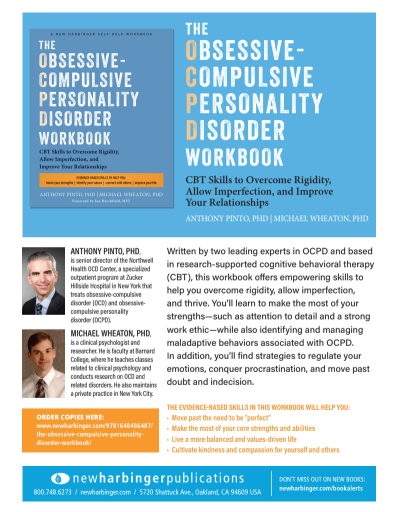
*Courtesy of New Harbinger Publications
S4E159: What If I’m The Villian In A Story My Brain Made Up? FAQ's about I-CBT Treatment for OCD with Michael Parker, LCSW
In this episode, Nicole Morris, LMFT sits down with Michael Parker, LCSW (OCD Space) for a deep dive into Inference-Based CBT (I-CBT) and some of the most common questions surrounding this evidence-based OCD treatment approach.
Together, they explore inferential confusion, feared possible selves, differences between ERP and I-CBT, and why emotionally powerful feelings do not equal evidence that OCD’s story is true. The episode also includes a practical case conceptualization to help listeners understand how I-CBT works in treatment.
Intrigued!? Come learn with us, because we continue to be better together.
Resources:
To learn more about Michael Parker, LCSW, check out the following resources:
ICBT Training Online: Learning available for clinicians and sufferers alike!
OCD Space: Mike’s YouTube Channel
To learn more about I-CBT more broadly, check out icbt.online
To learn more about I-CBT, check out past episodes on the OCD Family Podcast via the I-CBT Playlist
S4E158: OCD Treatment: Learning to Sail & Calm the Storm with Dr. Michael Greenberg
In this episode of the OCD Family Podcast, Nicole Morris welcomes back Dr. Michael Greenberg, licensed clinical psychologist and creator of Rumination-Focused ERP, to explore a deeper way of understanding OCD.
Dr. Greenberg shares insights from his article “OCD as a Defense Mechanism,” where he integrates behavioral approaches like ERP with psychoanalytic perspectives on emotional conflict and relational development. Together, Nicole and Michael discuss how OCD symptoms may function as defenses that displace difficult emotions into obsessions and compulsions.
This conversation invites clinicians, families, and those with lived experience to consider a both-and approach to OCD treatment—one that addresses symptoms while also exploring the emotional dynamics that may fuel them.
Resources:
To learn more about Dr. Michael Greenberg and OCD Associates, click here.
Jump directly to his article: “OCD As A Defense Mechanism”
To check out the last time Michael hung out with the fam & learn more about RF-ERP, click here.
S4E157: Self Care Isn't Selfish - Especially with OCD
In this shorter check-in episode, Nicole shares why choosing rest and regulation over pressure and perfection is sometimes the most important OCD work we can do. When life feels chaotic, self-care isn’t avoidance—it’s protecting your nervous system.
She also announces the re-release of key early episodes on YouTube, including conversations on supporting adult children with OCD and navigating higher levels of care.
If you’re overwhelmed or newly navigating OCD, this is your reminder: you’re not alone—and there is hope.
Full-length interviews resume next week.
Resources:
To check out the re-published videos mentioned on this week’s episode, click on the following:
S4E156: New Year, Same Fear
After an unplanned pause, Nicole is back—and she’s getting real about it. In this candid check-in episode, she shares why stepping away without over-explaining was actually an act of response prevention, not disappearance. OCD often demands perfection, performance, and constant reassurance—but sometimes the most regulated choice is silence.
As 2026 begins, she explores how “new year, same fear” can feel especially true with transitions and added pressure. OCD doesn’t reset at midnight. Still, familiar fear doesn’t mean lifelong suffering. Drawing from her experience as both a clinician and someone in recovery, Nicole reminds listeners that evidence-based treatments like ERP, ICBT, ACT, and medication offer real hope.
If you’re struggling—or supporting someone who is—this episode is a reminder: you’re not alone. We can sit with discomfort, choose values over fear, and build hope, even in quiet seasons.
Resources:
To learn more about Exposure and Response Prevention (ERP) or to find a provider through the International OCD Foundation, click here.
To learn more about Inference-Based CBT (I-CBT), click here.
To browse the self help or CE-eligible courses offered through OCD Training School using my special affiliate link, click here.
Additional Recommended Resources:
The Contamination OCD Workbook by Rich Gallaghar, LMFT: Click here
Rumination-Focused ERP (RF-ERP) by Dr. Michael Greenberg: Click here
Podcasts:
The OCD Whisperer: Click here for the YouTube channel
The OCD Stories: Click here for the YouTube channel
AT Parenting Survival: Click here for the YouTube channel
IG Profiles:
Madison Marie: @obsessivelystrong
Amanda Petrik-Gardner, LCPC: @anxietyocdtreatment
Natasha Daniels: @childocdtherapist
S4E155: Cards Against OCD: Ho-Ho-Holiday Edition
Welcome to our annual tradition of holiday games—where we raise awareness, build community, and sometimes laugh at OCD’s expense (because, why not?). This year, we’re playing Cards Against OCD: Ho-Ho-Holiday Edition, inspired by the classic Cards Against Humanity—but with an OCD-twist.
Nicole is joined by thrice fabulous colleagues and friends, Madison @obsessivelystrong Di Silvio, Krista Reed, LSCSW, and Tracie @tabootracie Ibrahim, as we dive into the absurd, rule-breaking prompts that challenge OCD’s relentless need for control. Spoiler: We do not follow OCD’s rules—we follow our own values. So what are you waiting for? Let laugh, learn and remember that we’re better together!
Resources:
To learn more about our guests from this episode, see below:
Madison Di Silvio:
To learn more about her work with the Chicago Counseling Center: Click here.
Follow Her on Social:
Instagram: @obsessivelystrong
TikTok: @obsessivelystrong
Krista Reed:
To learn more about her practice: Click here.
Instagram: @kristaruthreed
Tracie Ibrahim:
To learn more about her work in her practice: Click here.
To learn more about Tracie’s work with NOCD: Click here.
Instagram: @tabootracie
Also, don’t forget to check out Krista and Tracie’s pod, Talk Taboo To Me, streaming on Spotify Click here.
S4E154: OCRD Series IV, Part IV: When OCPD Takes Over Your Marriage: Real Stories & Solutions
In this final installment of our OCRD Series, we explore Obsessive-Compulsive Personality Disorder (OCPD) with Dr. Anthony Pinto and two special guests who bring powerful lived experience within the context of marriage and parenting. We discuss the difference between OCD and OCPD, how rigid thinking impacts relationships, and what growth looks like with a CBT Toolbox. Plus, we reflect on the hope available in the lifelong process of navigating OCPD. Finally, Nicole offer a values-based application practice to take with you into the holidays. So join the conversation, and let’s learn about OCPD!
Resources:
To learn more about the Northwell Health OCD Center & Dr. Anthony Pinto, Ph.D.,: Click here.
To learn more about the resources and support available at OCPD.org: Click here.
To learn more about the upcoming Self Help workbook, The Obsessive-Compulsive Personality Disorder Workbook: Cognitive Behavioral Therapy Skills to Overcome Rigidity, Embrace Imperfection, and Improve Your Relationships―and Your Life, for pre-order (Release date: July 2026): Click here.
To learn more about the parenting book Adam and Rebecca recommended during this episode, Parenting Teens with Love and Logic: Preparing Adolescents for Responsible Adulthood by Fay & Cline, : Click here.
To learn more about Gary Trosclair’s book, The Healthy Compulsive: Healing Obsessive Compulsive Personality Disorder and Taking the Wheel of the Driven Personality: Click here.
To check out our past episodes with Dr. Anthony Pinto regarding support and resources for OCPD,
S4E153: OCRD Series IV, Part III: ARFID: The One Diagnosis That Could Change How You See "Picky Eating" Forever
In Part III of our OCRD Series, we explore Avoidant/Restrictive Food Intake Disorder (ARFID), a serious eating disorder that often overlaps with OCD, anxiety, and sensory sensitivities. Host Nicole Morris, LMFT, breaks down how ARFID shows up in real life, courtesy of a FEAST presentation by Dr. Sarah Ravin, Ph.D., on how ARFID differs from typical picky eating, and what treatment options can help individuals and families navigate recovery. Additionally, Nicole provides some practical examples as she provides live reaction to Hannah Lea's bravery on her channel, @MyARFIDlife. So join the conversation, and leave with lots of hope! Because if anything, we're reminded that we're not alone.
Resources:
To learn more about FEAST (Families Empowered And Supporting Treatment) for Eating Disorders: Click here.
To learn more about guest speaker for ARFID 101 hosted by FEAST, Dr. Sarah Ravin, Ph.D.: Click here.
To check out the FEAST YouTube Channel: Click here.
To watch exerts or the full video of Dr. Ravin’s presentation, click the YouTube video below:
To check out past episodes of OCD Family Podcast referenced during this episode, see below:
S1E39: The Incredible Overlap Between Eating Disorder & OCD with Dr. Jenna DiLossi, PsyD
S2E88: Exposed: The Life Changing Benefits of Facing Your Fears for IBS & OCD with Dr. Melissa Hunt, Ph.D.
To learn more about the Nine Item ARFID Screen (NIAS), click here.
To learn more about the 2023 research by Sanchez-Cerezo et al, click here.
To learn more about the adorable Hannah Lea, like and follow her on the following:
Instagram: @myarfidlife
YouTube: @MyARFIDLife
All of the following YouTube videos were reviewed for this episode. Click on the corresponding title to watch the video in full, follow Hannah and her family’s ARFID journey, or share:
Hannah’s Mom: MY MOM TALKING ABOUT ARFID AND HOW WE STARTED THIS JOURNEY
Exposure #1: SAFEFOOD
Exposure #2: BAGEL WITH BUTTER
Exposure #3: FEAR FOOD
Why 3 Bites: HANNAH’S 3 BITE RULE
Intrusive Thoughts Application: BEING UNCOMFORTABLE TO GET COMFORTABLE
S4E152: OCRD Series IV, Part II: Understanding BDD: What Families & Clinicians Can Learn from Kimberley Quinlan & Chris Trondsen, LMFTs
BDD (Body Dysmorphic Disorder) affects millions, but quality education for both clinicians AND families has been hard to find—until now. In this episode, Nicole sits down with Kimberley Quinlan, LMFT—host of the highly successful Your Anxiety Toolkit podcast & Chris Trondsen, LMFT—to get an exclusive overview of their groundbreaking new BDD course with CBT School. What makes this course special? It offers TWO distinct tracks, a clinical training path and a lived experience family track. Chris and Kim give us a bird's-eye view of what each track covers, who it's designed for, and how this course fills a critical gap in BDD education. Ready to dive deeper? Whether you're a family member seeking understanding or a clinician expanding your toolkit, this conversation will show you what's possible when expert knowledge meets compassionate education.
Resources:
Want to learn more about Kimberley and Chris’ course, Your BDD Toolkit: Click here.
To learn more about Kimberley Quinlan, LMFT,
And her practice: Click here.
To listen to Your Anxiety Toolkit on Spotify: Click here.
To visit CBT School more broadly: Click here.
To learn more about Chris Trondsen, LMFT,
And his practice: Click here.
To learn more about the online support group for family members, hosted by Chris and his mother, Liz: Click here.
To check out Chris’ previous episodes on OCD Family Podcast,
S1E15: Part II: Body Dysmorphic Disorder (BDD) with Chris Trondsen, LMFRT, APCC, & Liz Trondsen
S3E122: When Fear’s Ablaze: Mental Health Tips For Coping With Crisis
To learn more about the IOCDF SoCal Online Conference, running 11/15-16/2025: Click here.
To learn more about the broader affiliate and partner organizations through the IOCDF: Click here.
To check out IOCDF’s BDD-specific website: Click here.
S4E151: OCRD Series IV, Part I: BFRBs Explained: Lived Experience Meets Psychological Expertise to Benefit Families
In this episode of our 4th Annual OCRD Series, we explore trichotillomania, skin picking, nail biting, and other BFRBs from two essential perspectives: someone living with these challenges and a treating psychologist specializing in OCD and related disorders.
Whether you're a family member, partner, parent, or chosen family trying to understand BFRBs, or someone experiencing these behaviors yourself, this conversation offers real insights into what helps and what doesn't. Special guests, Jason Yu and Dr. Lisa Conway, discuss common struggles and goals while honoring the lived experience that statistics and clinical language can't capture. So join us for the conversation for lots of hope and practical guidance for loved ones and chosen family supporting BFRB warriors!
Resources:
To learn more about Jason Yu’s work, including his YouTube Channel for the Fidget Podcast, click here.
To learn more about the amazing Dr. Lisa Conway, check out her practice by clicking here.
If you want to learn more about either of the sensory panels Lisa has participated in previously with the fam, see the following:
S2E91: Part I: Sensory Panel: How Does OCD, OT, Being Autistic, BFRBs & Tics Affect Sensory Regulation
S2E92: Part II: Sensory Panel: Unlocking Hope: Approaching Sensory Experiences With A Curious Mind
To check out the original BFRB Water Cooler Chat Nicole created in consultation with Lisa during Season 1, click play below:
S4E150: Voices Of OCD: Stories That Help Break The Silence
In this special episode of the OCD Family Podcast, host Nicole Morris, LMFT, wraps up OCD Awareness Month by highlighting powerful stories from public figures like Scheana Shay, Braden Smith, Zane Gonzalez, Aly Raisman, Camila Cabello, and Howie Mandel as they share about their lived experience with OCD.
Nicole offers clinical insight and family-focused commentary on themes like religious scrupulosity, perinatal OCD, medication, and the stigma surrounding OCD — reminding us that this disorder doesn’t discriminate, and that speaking out makes a difference. So join the conversation!
Resources:
Scroll through the guests to find corresponding full interviews from the original, cited sources in full:
Scheana Shay:
The International OCD Foundation: Speaking Up: Scheana Shay’s Journey with PostPartum OCD
To learn more about the Perinatal OCD Resource Center through the IOCDF: Click here.
Braden Smith:
To learn more about Braden’s OCD story, courtesy of the Indianapolis Star, please see the 3 part series below:
Zane Gonazalez & Aly Raisman:
The International OCD Foundation: Winning Against OCD: Pro Athletes on Strength, Stigma and Success
To learn more about support and resources that can aid Anxiety in Athletes, check out the IOCDF by clicking here.
Camilla Cabello:
Therapuss with Jake Shane:
Medication Recommendations from the International OCD Foundation (IOCDF): Click here.
Provider Searches:
IOCDF: Click here.
I-CBT: Click here.
Howie Mandel:
NOCD: Get to know OCD, Ep 2: Howie Mandel on OCD and turning pain into purpose
Additional Citations:
To learn more about the stat reported from the World Health Organization during this episode, click here.
S4E149: Season 4 Premiere: We Walked For OCD Awareness & Here’s What Happened!
Season 4 is HERE! Join the kick off with your host, Nicole Morris, LMFT and Mental Health Correspondent, as we discuss Indiana's first-ever IOCDF OCD Walk sponsored by OCD Midwest. Clinicians, families, and partners united to raise awareness and access to evidence-based treatment. In this season premiere, discover what made this groundbreaking event so powerful and why it matters for the OCD community worldwide. In this episode, Nicole will cover the significance of Indiana's first-ever IOCDF OCD Walk, how clinicians and community partners united for OCD awareness, stories from family members and intimate partners who joined, evidence-based practices that are changing lives and what this historic event means for OCD advocacy moving forward. So join the conversation because we are better together!
Resources:
Check back on 10/11/2025 for a full posting of all the resources mentioned during this episode. <3
S3E148: Water Cooler Chats: You’re Stronger Than Your Fears
In our final water cooler chat of Season 3, join Nicole as we dive into what real courage looks like for OCD families—facing fears, bearing discomfort, and building resilience through ERP and I-CBT. Whether you’re supporting a loved one or on your own recovery journey, this episode is a heartfelt reminder that every act of bravery counts and that you’re never alone. Join us as we celebrate our community’s strength and look forward to Season 4!
Resources:
To learn more about ERP, click here.
To learn more about I-CBT, click here.
To learn more about OCD Training School’s amazing catalogue of courses for self help and professional trainings through my affiliate link, click here.